
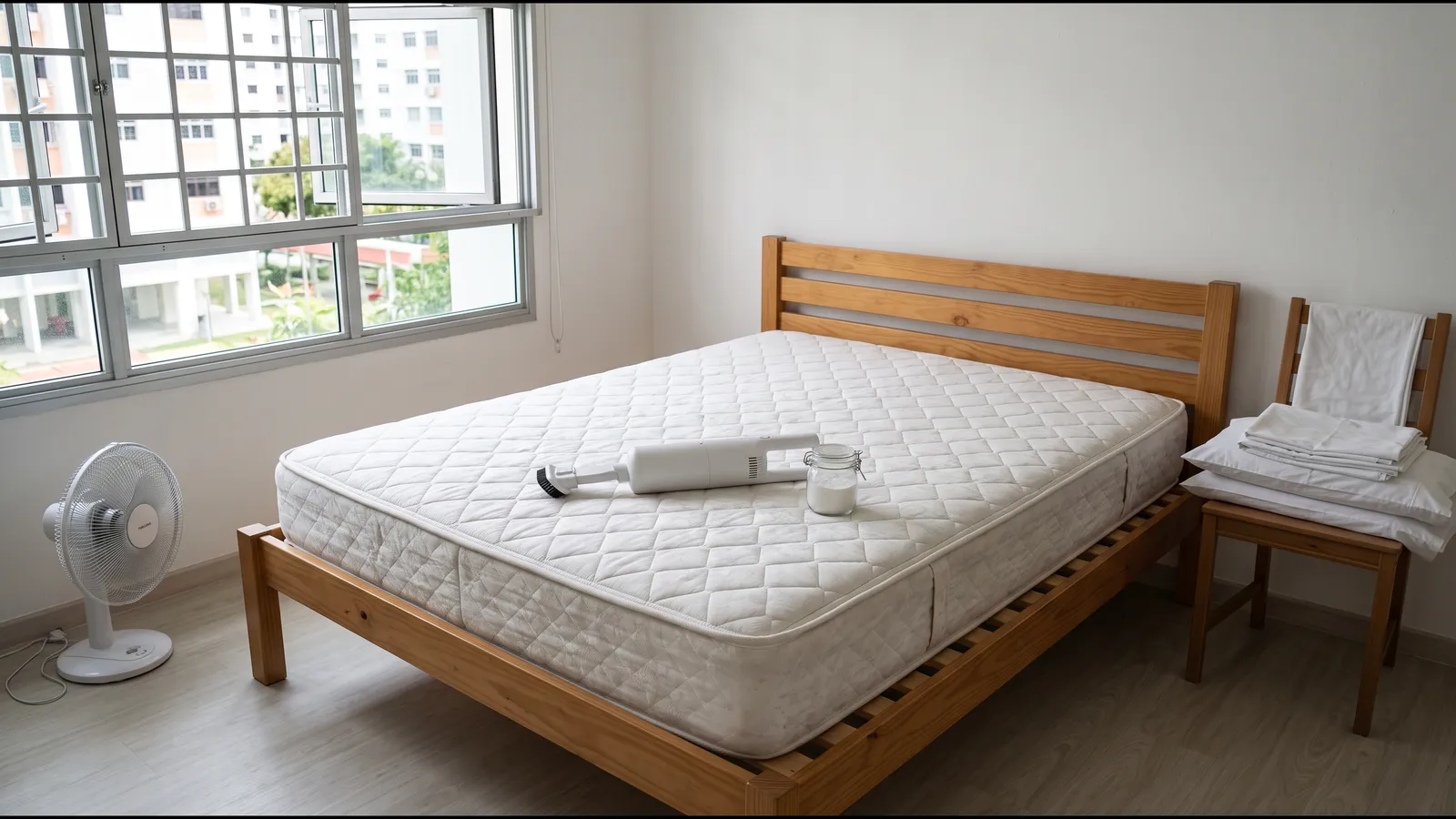
To clean a mattress at home, strip the bed and wash the bedding hot, vacuum the mattress slowly with the upholstery tool, sprinkle on baking soda and leave it for several hours, then vacuum it off and air the mattress with a fan. Do this about once a month. In a humid Singapore flat, keep water to a minimum and skip the long sunbath. A professional deep clean every 6 to 12 months handles what home cleaning can't reach.
The short answer
- Routine: strip and hot-wash the bedding, vacuum slowly (seams too), deodorise with baking soda, then air with a fan.
- Never soak it: in Singapore's humidity a wet mattress dries slowly and can turn musty or mouldy.
- Skip the harsh sun: a fan and open windows air it more gently than hours of direct sun.
- Home steaming: light surface passes only, with plenty of airflow, and dry fully before making the bed.
- Deep clean: professionally every 6 to 12 months, closer to 6 with a baby, allergies or eczema.
The routine clean, step by step
This is the clean you do about once a month. You need a vacuum with an upholstery tool and a crevice tool, a box of baking soda, a fan and a washable mattress protector.
1. Strip the bed and wash everything hot
Take off the sheets, pillowcases and protector, and wash them on the hottest setting each care label allows. Bedding holds the same sweat and skin flakes as the mattress, so clean both together.
2. Vacuum slowly, seams included
Go over the top with the upholstery tool in slow, overlapping strips. A quick pass picks up the visible fluff and leaves the fine dust behind. Then run the crevice tool along the seams, piping and tufts, where dust collects most, and finish with the four sides. A mattress vacuum or good handheld works well. A UV lamp is a bonus at most: the slow suction does the real work.
3. Deodorise with baking soda
Shake a thin, even layer of baking soda over the surface and leave it for several hours. It helps absorb the stale, sweaty smell our heat leaves behind. Keep it dry, with no paste and no spray bottle, then vacuum it all off using the same slow strips.
4. Air it with a fan, then make the bed
Open the windows and point a fan across the bare mattress while the bedding dries. Put the protector and sheets back only once everything is fully dry.
Why sun and water are risky in a Singapore flat
Much of the mattress advice online assumes a garden and a dry summer. Neither the long sunbath nor a good wash suits an HDB or condo bedroom.
Direct sun sounds healthy, but long hours of harsh sun can be hard on some foams and can fade the cover. Few flats have room to lay a queen mattress out anyway. A fan, with the windows open or the aircon on, airs it more gently.
Soaking is the bigger risk. Water that gets past the cover has no quick way out of a thick block of foam and padding. In Singapore's warm, humid air it dries slowly, and damp padding is where mould, musty smells and dust mites thrive. (Our guide to dust mites in the mattress explains why the bed is their favourite spot.) So never pour liquid on a mattress or scrub it with a wet brush. If a mark needs attention, use a barely damp cloth on the smallest area you can.
Can you steam clean a mattress at home?
You can, carefully. A handheld steamer puts heat and moisture into the surface. That can refresh the top layer, and the heat may kill dust mites it actually reaches. What it can't do is pull anything back out, so the dirt, sweat and water stay in the mattress. It's the same moisture problem we cover in our guide to steam cleaning a sofa, and a mattress is thicker. If you do steam:
- Check the maker's care guidance first. Some foam mattress makers advise against heat or steam.
- Use light, quick passes and keep the head moving. Never hold it in one spot.
- Run a fan across the mattress and open the windows straight after.
- Wait until it is fully dry before the sheets go back.
Keep it fresh between deep cleans
Two habits do more than any cleaning product. A washable mattress protector takes the night sweat, spills and accidents, so you wash the protector instead of treating the mattress. And rotating the mattress head to foot every few months helps it wear evenly. Only flip it if the maker says it is two-sided, since many modern mattresses are made to be slept on one side only.
If urine, blood or a bad night sweat does get through, our mattress stain removal guide takes each stain in turn. For everything else, here is the routine to come back to.
Monthly mattress routine
Tick each step as you go.
When to book a professional deep clean
A monthly routine keeps the surface fresh. It doesn't reach the sweat, body oils and dust mite build-up deep in the padding, so we recommend a professional deep clean every 6–12 months, or closer to every 6 if there is a baby in the home or anyone who sleeps on it has allergies or eczema. See how often to clean your mattress, sofa and curtains for the full schedule.
BRISC's mattress cleaning is done in your home. After a patch test, we remove dry soil, pre-treat stains, then use hot-steam extraction, which flushes dirt out and pulls most of the moisture back out. An eco sanitiser, deodorising and a fast-dry finish follow. It removes 99.9% of dust mites and bacteria, the solution is safe for babies and pets once dry, and most mattresses are dry in 2–4 hours. Stain removal isn't guaranteed, because it depends on the stain and its age.
Prices cover the top and four sides: S$55 for a single, S$70 for a super single, S$85 for a queen and S$95 for a king. Adding the underside is +50%, with a S$70 minimum order per visit.
Frequently asked questions
How do you deep clean a mattress at home?
Is mattress steam cleaning worth it?
How long should baking soda stay on a mattress?
Should I put my mattress in the sun in Singapore?
How long does a mattress take to dry after professional cleaning?
Time for a proper mattress deep clean?
Send us a photo of your mattress on WhatsApp and we'll reply with a clear, all-in price, usually within the hour during the day. Most mattresses are dry in 2 to 4 hours.