The most effective way to remove formaldehyde from a newly renovated home is ventilation. That is the National Environment Agency's own advice: open windows and doors on opposite sides, run fans, and keep it up for several weeks after the work ends. Reducing the source matters too, so ask about the boards in your carpentry and furniture. Purifiers and treatments can only sit alongside that. Here is how to do it calmly, test properly and deal with the renovation dust.
The short answer
- What works first: NEA says ventilation is the most effective way to remove formaldehyde. Open windows and doors on opposite sides and use fans.
- How long: NEA advises extending ventilation for several weeks after a renovation is completed.
- Where it comes from: composite wood such as particleboard and MDF carpentry, some adhesives and some interior paints.
- Testing: use a lab accredited by the Singapore Accreditation Council (SAC). Cheap sensors can give misleading readings.
- Purifiers: NEA says there is limited data on how well air cleaners remove formaldehyde, so reduce the sources first.
Where formaldehyde in a new home comes from
Formaldehyde is a chemical used in some building and furniture materials. The National Environment Agency (NEA) explains in its advisory on formaldehyde in interior building products that formaldehyde-based resins may be used to make composite wood products and some adhesives. Formaldehyde may also be added to some interior paints as a preservative or biocide.
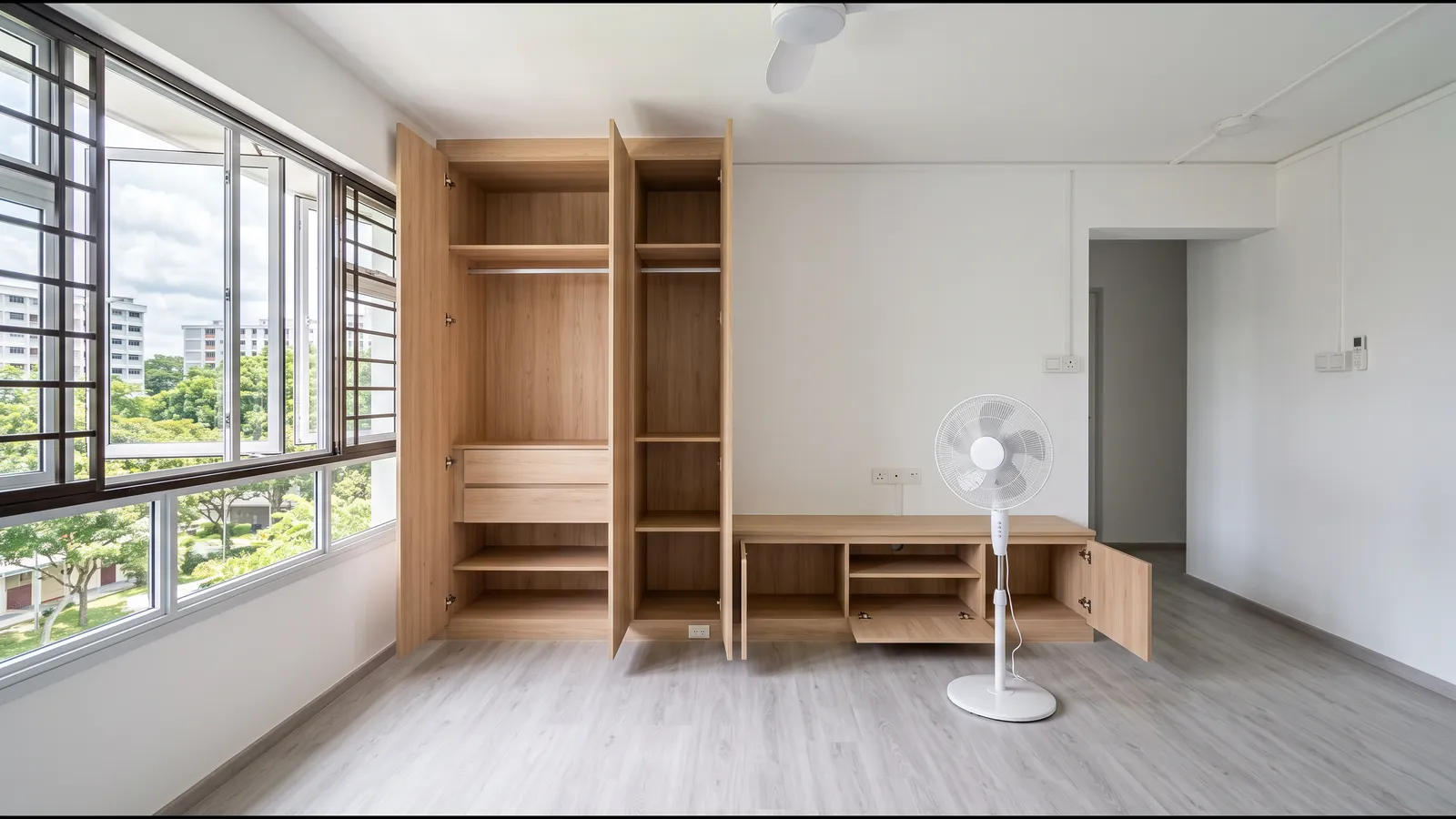
In a Singapore renovation, composite wood often means the carpentry: the particleboard and MDF behind the laminate of your kitchen cabinets, wardrobes, TV console and shoe cabinet. New loose furniture made from the same kinds of board counts too. A renovation can bring a lot of new board into a small flat all at once, which is why the question so often comes up right after handover.
Paint is changing. NEA notes that from 1 January 2026, interior paints with a formaldehyde content of 0.01% (weight by weight) or more can no longer be manufactured, imported or sold for local use in Singapore. That rule covers paint only. It does not cover carpentry, furniture or adhesives, so those are where your own questions are best spent.
What it can do, in NEA's words
NEA says short-term exposure may cause some people irritation of the eyes, nose, skin and throat. Long-term exposure to high concentrations has been associated with asthma and some forms of cancer.
Two words in that second sentence matter: long-term and high. A sharp smell inside a new wardrobe is a reason to air the room well, not a reason to panic. If anyone at home has symptoms that worry you, especially a baby, an older relative or someone with asthma, speak to a doctor.
You may also see a figure quoted online. The Singapore Standard code of practice for indoor air quality in air-conditioned buildings, SS 554, recommends a voluntary limit of 0.1 mg/m³ (0.08 ppm) over any 30-minute period. Homes are excluded from that standard, so treat it as a reference point for reading a lab report, not as a legal limit for your flat.
What NEA says works first: fresh air
NEA is clear that the most effective way to remove formaldehyde from indoor spaces is ventilation. Open windows and doors on opposite sides of the home so air can move straight through, and use fans to help disperse it.
That is harder than it sounds in Singapore, where many households run the aircon with everything shut. Most home split-unit aircons cool the air already in the room rather than bringing fresh air in, so a cold, closed bedroom is not a ventilated one. Air the room with the windows open first. Then close up and cool it if you need to.
NEA also advises planning to extend ventilation for several weeks after a renovation is completed, and considering a delay before moving into heavily renovated areas. If you have not started yet, it suggests specifying low-formaldehyde building products in the renovation contract and talking to your contractor about ventilation, including ventilation time in the schedule.
Here is a practical version for the weeks after you get your keys back.
Your first weeks after handover
Tick each one off as it becomes part of your routine.
Testing, and the reports to ask for
If you want to know your actual levels, NEA's advice is to contact a local laboratory accredited by the Singapore Accreditation Council (SAC). An accredited lab gives you a report with a number you can read against a reference point such as SS 554.
Why a cheap sensor can mislead
Low-cost formaldehyde meters are easy to buy online. NEA notes that their accuracy is affected by where they are placed, how long they are used, how the data is processed, temperature, relative humidity and other contaminants in the air. Humidity is on that list, and Singapore has plenty of it. A freshly renovated flat also has plenty of other new smells in the air. A sensor may show you a rough trend in one spot, but do not use its reading alone to decide that a room is safe or unsafe.
Ask for the emission reports
NEA says consumers may ask furniture companies for the panels' formaldehyde emission test reports from labs accredited under ILAC-MRA, an international arrangement that recognises accredited labs. You can put the same question to your carpenter or interior designer about the boards in your built-in carpentry. A seller who can show you a report from an accredited lab gives you something concrete to go on. Ask before you buy or sign, while it is still easy to choose a different board.
Air purifiers, treatments and other quick fixes
Search for formaldehyde removal and you will find air purifiers, sprays, charcoal bags and treatment services, often with strong promises. Keep NEA's position in mind: there is currently limited data on how well air cleaners remove volatile organic compounds such as formaldehyde, so reduce the sources first.
That does not mean every product is useless. It means none of them should replace fresh air and a careful choice of materials. If you already own an air purifier, keep the windows open anyway. It is not a substitute for ventilation.
The same thinking applies to formaldehyde treatments, including ours. A treatment, if you choose one, sits alongside ventilation and good materials, not instead of them. It is not a reason to move a newborn into a room that was finished last week, or to keep the windows shut. Ask any provider plainly what the treatment involves and what it can and cannot do. If you want numbers, an SAC-accredited lab test is the route NEA points to.
Where a post-renovation clean fits
A renovation leaves more than smells. Fine dust from sanding, cutting and drilling settles everywhere, and soft furnishings hold on to it. Curtains hung before the work finished, a sofa that stayed in the flat under a sheet, mattresses and rugs all collect it deep in the fabric, where a wipe-down never reaches. In Singapore's humidity, dusty fabric that stays slightly damp is also where dust mites and musty smells do well.
That dust is a separate job from formaldehyde, and it is the part a good clean handles well. BRISC's post-renovation cleaning is a whole-home handover deep clean plus floor deep cleaning, with vinyl, tiles and stone scrubbed. It is quoted after a quick survey and takes from half a day to a full day, depending on the home. Our post-renovation cleaning checklist covers what to check room by room.
For fabric, our curtain cleaning is done on-site with steam, with no taking down and no shrinkage, and the curtains are hung the same day. Sofas get hot-steam extraction through our upholstery cleaning, and mattresses are cleaned the same way, with an eco-friendly, non-toxic solution that is safe for babies and pets once dry. If you are setting up a nursery, our guide to baby- and pet-safe fabric cleaning is worth a read. To be clear, cleaning fabric removes dust and dirt. It is not a formaldehyde treatment.
BRISC also offers an optional formaldehyde treatment as an add-on to the post-renovation clean, for new renovations and new furniture. If you would like to know what it involves, ask us on WhatsApp before you book. Either way, keep the windows open.
Frequently asked questions
Is formaldehyde from new furniture dangerous?
Do air purifiers remove formaldehyde?
How long does formaldehyde smell last after renovation?
How do I test for formaldehyde at home in Singapore?
Does steam cleaning a sofa remove formaldehyde?
Just renovated? Let's clear the dust
Send us a few photos on WhatsApp for a post-renovation cleaning quote. You can also ask what our optional formaldehyde treatment add-on involves.