
You sit down, and there it is again, that faint musty or sour note that no amount of Febreze quite fixes. A smelly sofa isn't a sign you're a messy household. It's what happens when soft fabric, warm bodies and Singapore's humidity meet, day after day. Here's why it happens, what actually helps at home, and the point where masking the smell stops working and you need to remove the source.
The short answer
- Why it smells: fabric and foam soak up body oils, sweat, food, drink and moisture.
- The actual smell: bacteria and mould feeding on that build-up in a damp environment.
- Why Singapore is worse: constant humidity keeps the sofa damp, so odour builds faster.
- DIY helps surface smells: vacuum, baking soda, airing, a light fabric-safe spray.
- DIY can't reach deep odour: once it's in the foam, only hot-steam extraction removes the source.
Why a sofa starts to smell
A fabric sofa is basically a giant sponge you sit on every day. The upholstery and the foam beneath it quietly soak up everything that touches them: body oils and sweat from bare skin, crumbs and drips from snacks and drinks, pet dander, and plain old moisture from the air and from damp clothes. None of that smells much on its own. The problem starts when it sits there.
Warmth and moisture are exactly what bacteria and mould need to grow, and a well-used sofa gives them both. As those microbes feed on the trapped oils and food residue, they release the by-products we register as a smell, the musty, sour or "old fabric" note that seems to come from nowhere. That's the real source: not the dirt itself, but the bacteria living on it.
This is where Singapore's climate makes things harder. In a drier country a sofa gets a chance to dry out between uses. Here, the air is warm and humid almost every day of the year, so the fabric stays slightly damp and never fully resets. That damp environment lets bacteria and mould keep working, which is why sofas in Singapore homes tend to pick up a smell faster, and hold onto it longer, than the same sofa would elsewhere.
Find the source first
Before you reach for any product, work out where the smell is coming from. Different sources need different fixes, and treating the wrong one just wastes effort. Press your nose close to different parts of the sofa, lift the cushions, and check underneath. A few usual suspects:
- Spills that soaked in: milk, coffee, juice or soup that went past the surface. These smell sour or sweet and are often worst in one spot.
- Pet accidents: urine soaks deep and the smell returns whenever the fabric gets warm or damp. Usually sharp and unmistakable.
- Damp from humidity or aircon: a general musty smell across the whole sofa, worse in a closed, air-conditioned room with little airflow.
- Food in the cushions: crumbs and grease trapped in the seams and under the cushions, a stale rather than sharp smell.
- Smoke: cigarette or cooking smoke clings to fabric and builds up over time, noticeable most when the room is warm.
If the smell is in one clear patch, you're likely dealing with a spill or an accident. If the whole sofa smells musty, humidity and bacteria are the more likely cause, and airflow becomes part of the fix.
Common smells and what they mean
Use this as a quick guide to match the smell to its likely cause and the sensible first step. In every case, if the odour keeps returning after you treat the surface, it has soaked deeper than DIY can reach.
| What you smell | What it usually means | First fix to try |
|---|---|---|
| Musty / damp | Moisture and bacteria from humidity | Air the room, run aircon or a dehumidifier, baking soda |
| Sour / sweet in one spot | A drink or food spill that soaked in | Blot, then treat the spot; extraction if it lingers |
| Sharp, ammonia-like | A pet accident in the foam | Extraction, sprays only mask it |
| Stale, greasy | Food and crumbs in the cushions and seams | Deep vacuum under and between cushions |
| Smoky | Cigarette or cooking smoke built up over time | Air out, then professional deep clean |
What you can do at home
For a mild, surface-level smell, a proper home clean often makes a real difference. Work through these in order:
- Vacuum thoroughly, including under the cushions. This is the single most effective step most people skip. Lift every cushion, get into the seams and corners, and clear out the crumbs, dust and dander that feed the smell in the first place.
- Sprinkle baking soda, then vacuum it up. Scatter a light, even layer over the fabric, leave it for a few hours (overnight if you can), then vacuum it all off. Baking soda absorbs surface odour and freshens mild smells well.
- Blot fresh spills immediately, don't rub. Press a clean, dry cloth straight down to lift the liquid before it soaks in. Rubbing spreads the spill and pushes it deeper into the foam, which is exactly what you're trying to avoid.
- Air the room and cut the humidity. Open the windows for cross-breeze, or run the aircon or a dehumidifier in a closed room. Drying the fabric out slows the bacteria and mould that cause musty smells, this matters more in Singapore than almost anywhere.
- Finish with a light, fabric-safe spray. A gentle upholstery-safe freshener can lift the last of a mild smell. Use it sparingly, a soaking spray adds moisture, which in humid weather can make things worse rather than better.
These steps genuinely help a sofa that smells a little tired. What they can't do is reach odour that has already soaked down into the padding, and that's where a lot of stubborn smells actually live.
What DIY can't fix
Here's the honest limit of home methods. Once a smell has soaked into the foam, whether from months of body oils and humidity, a spill that went deep, or a pet accident, sprays and powders only reach the surface. A spray makes the sofa smell nice for a day or two, then the odour returns as it wears off, because the source is still sitting in the padding untouched.
Worse, most sprays add moisture. In Singapore's humidity that extra dampness is slow to dry, and damp foam is exactly what mould and bacteria want. So masking a deep smell can quietly make the underlying problem grow. You end up spraying more often, chasing a smell that keeps coming back.
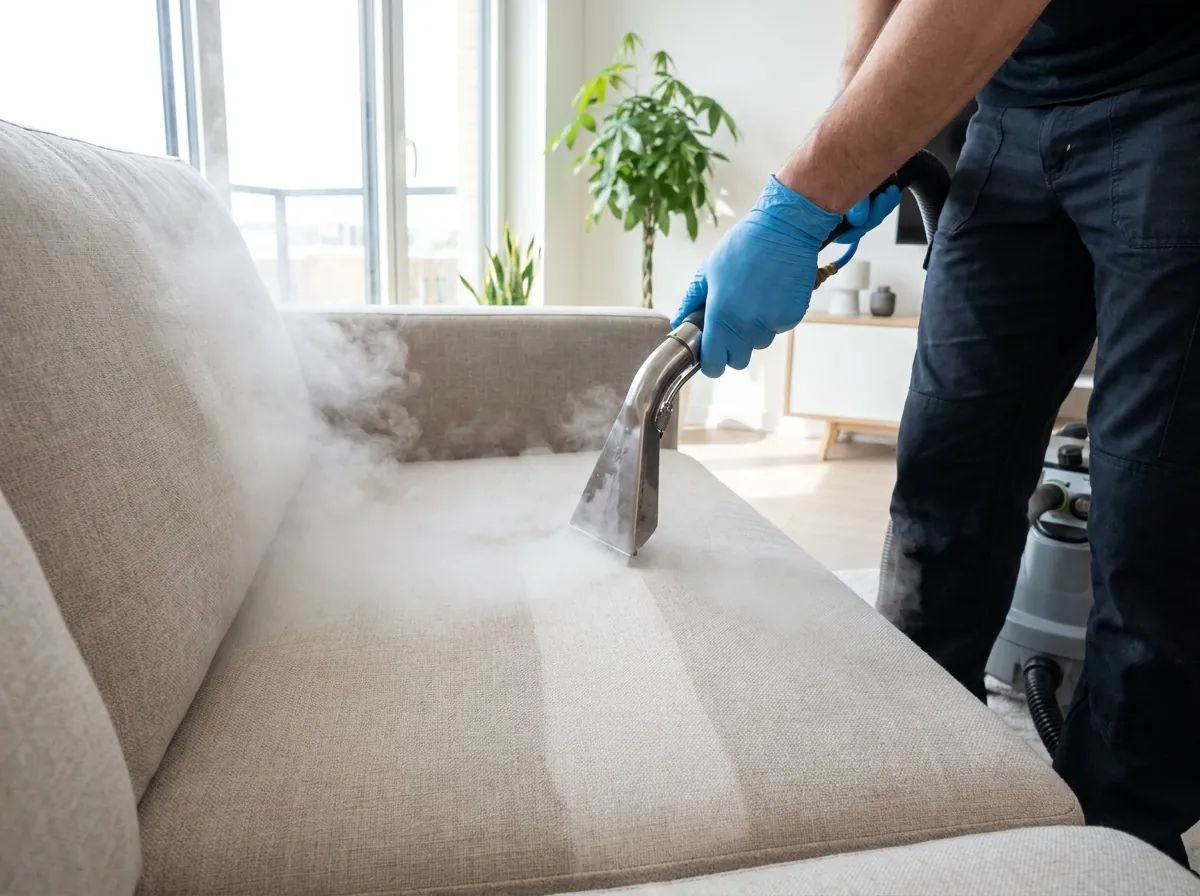
The only real fix for deep odour is to remove the source, and that means hot-steam extraction. Rather than sitting on top of the fabric, extraction flushes hot steam and an eco, non-toxic solution through the upholstery and then pulls the moisture, along with the trapped oils, residue and the bacteria causing the smell, back out. That's what actually clears the odour instead of covering it. It's the core of how we clean at BRISC: our process removes 99.9% of dust mites and bacteria, uses a non-toxic solution that's safe around babies and pets, and because most of the moisture is drawn back out, the sofa is dry and usable again in 2 to 4 hours. Upholstery cleaning starts at S$55 for an armchair or single seat, with a S$70 minimum order. A home steamer is not the same thing, as our guide to steam cleaning a sofa explains.
Stopping the smell coming back
Once the source is gone, keeping a sofa fresh is mostly about routine and moisture:
- Deep clean every 6 to 12 months. A professional clean once a year keeps most sofas genuinely fresh; move to every six months if you have pets or young kids who eat and nap on it. Our guide on how often to clean your sofa in Singapore breaks the timing down room by room.
- Keep the humidity down. Run the aircon or a dehumidifier in the room, and let air move through when you can. A drier sofa simply doesn't grow the bacteria that smell.
- Deal with spills fast. Blot straight away, don't let anything sit and soak in. The spills you catch in the first minute rarely become the smells you fight for months.
- Vacuum weekly. Regular vacuuming under the cushions clears the food and dander before it has a chance to break down and smell.
Do those four things and a smelly sofa becomes a rare event rather than a recurring one. If yours already smells and the DIY steps aren't holding, that's the sign the odour is deeper than the surface, and worth a proper clean.
Frequently asked questions
Why does my sofa smell musty in Singapore?
Does baking soda remove sofa smells?
Can you get pet smell out of a sofa?
How long does it take for a cleaned sofa to smell fresh again?
Get the smell out for good
If the sprays have stopped working, the smell is deeper than the surface. Send us a photo of your sofa on WhatsApp and we'll tell you honestly what's causing it and what a proper clean would cost. No obligation, no upsell.